LIVE Vlogs
-
![]()
Remember When KG Was All About Play?
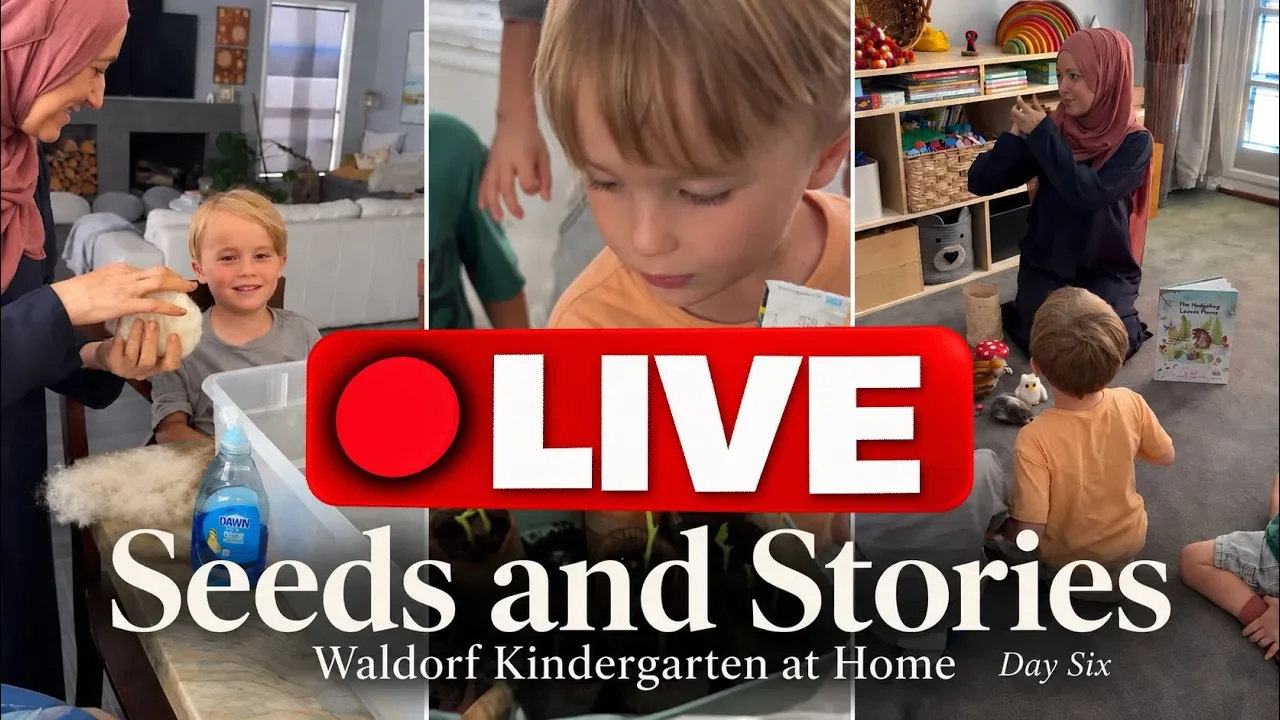
Today we continued a project we started last week when the children cleaned and carded raw wool. We're using that wool to make wet felted balls. I prepared the cores ahead of time using leftover pieces of felt and yarn, and then the children wrapped their carded wool around them.
-
![]()
Wet Felted Wool Balls
I've done this project with children of different ages, and I've learned that demonstrating is much more effective than giving a lot of verbal instructions. I also found that if I get each child's project started and make sure the wool is beginning to hold together, they can continue quite successfully on their own.
-
![]()
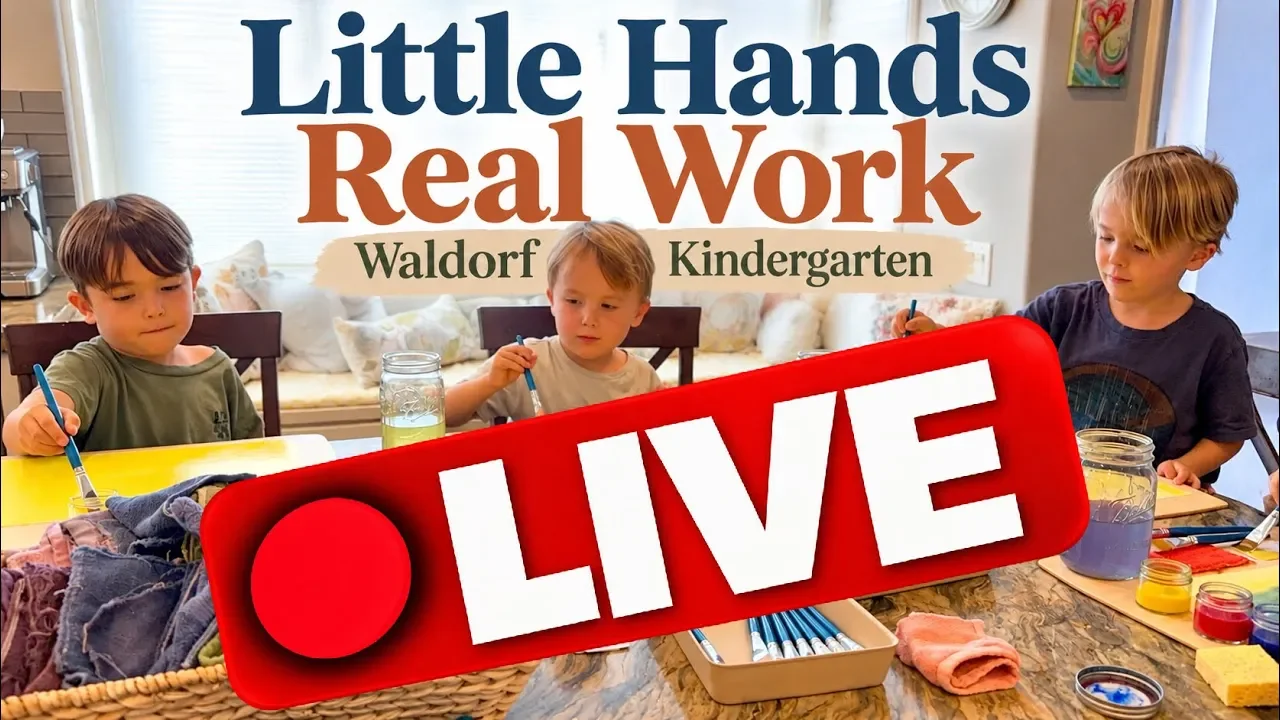
Our Third Week
I had actually prepared a watercolor activity for them, but they were playing so beautifully that we decided not to interrupt them. My 15-year-old daughter brought out some of the dress-up clothes my own children played with when they were younger, along with some pirate money, and she kept them engaged for quite a long time.
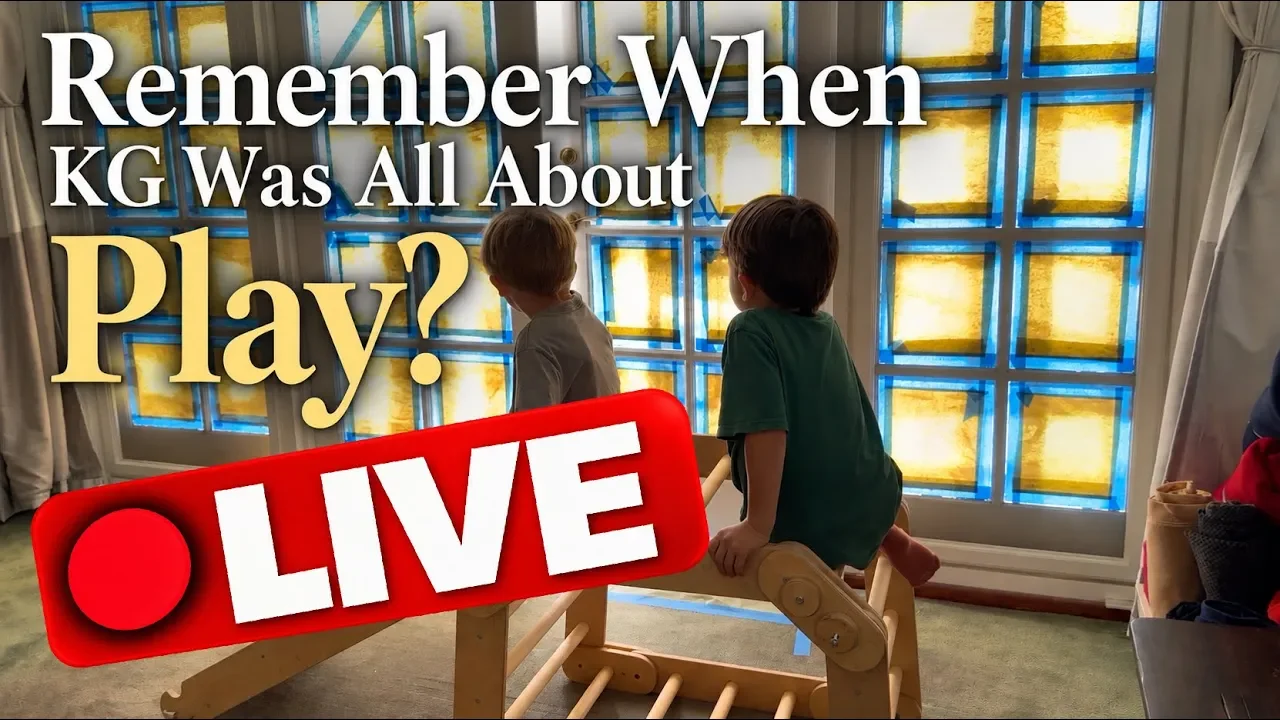
Remember When Kindergarten Was All About Play?
Wednesday, September 9, 2026 | Day 6
Welcome to the LIVE audio version of our homeschool vlogs. In these videos, you'll hear the delightful voices of the children, my verbal instructions to the children (often too much instruction) and the quiet and slow between the projects, and the laughter and joy of the play. Remember when Kindergarten used to be about play? Let’s look at the some of the benefits.
I've been homeschooling my four-year-old triplet nephews for a few weeks now, and we're starting to establish a really solid rhythm. I'm still very much in the observation phase, learning more about the children and figuring out how much we can realistically accomplish each day. Time management continues to be one of my biggest challenges because we get so engaged in our projects. I'm realizing that two hours, twice a week, really isn't enough time for everything we want to do.
Today we continued a project we started last week when the children cleaned and carded raw wool. We're using that wool to make wet felted balls. I prepared the cores ahead of time using leftover pieces of felt and yarn, and then the children wrapped their carded wool around them.
For the wet felting, we worked back and forth between warm water and ice cold water. I found that the project was much more successful when I initially dipped and worked each child's ball myself until the wool was beginning to hold together. Then the children could continue the process, moving their balls between the warm and cold water until they were nearly finished. Once the balls were felted, we added them to a dye pot to dye them yellow.
Next, it was time to prepare our snack. Today we made chia seed pudding with coconut milk, bananas, and coconut flakes. I ground the chia seeds first, although you could certainly leave them whole. Each child held a measuring cup over their own bowl while I poured in the coconut milk. This worked so well because if anything spilled, it simply fell into their bowl. They were so careful and precise with each step.
While the chia pudding began to thicken, I gave each child half a banana to cut. We used their plates instead of cutting boards because that's one thing I still don't have enough of for every child. They've had quite a few opportunities to work with knives now, and I'm seeing them become much more comfortable and confident with them while still being careful. They finished their pudding with a couple of scoops of coconut flakes, and they really enjoyed this snack.
After eating and cleaning up, we headed into the playroom for some free play. While the children were playing, one of them noticed the little pots of seeds they had planted during a previous lesson and wanted to see how much they had grown.
This turned into an unexpected part of our lesson. We brought down all of the pots and looked closely at what had happened. Some seeds hadn't sprouted at all, while others were in different stages of growth. Some pots even had two seeds growing. We counted the seedlings, compared the different pots, and spent some time simply observing what had changed.
I love that this wasn't something I had planned for the day. The children's own curiosity brought us back to the seeds, and there was so much to observe. Soon we'll need to transplant the seedlings into larger pots, which will give us another project for an upcoming lesson.
We concluded our day with our story, The Hedgehog Leaves Home. We're still reading just a couple of pages at a time, and our collection of props continues to grow as new animals appear in the story. I keep finding myself running upstairs to the school room to find another little animal to add.
The children are so engaged with the props. Today they were particularly interested in a little metal spider that they could hold, squeeze, examine, and pass around. As the hedgehog and mouse ran up a hill in the story, each child received a little hedgehog and mouse to run up one arm, over their head, and down the other side. These little interactions are so simple, but they bring so much joy to the children and to me.
There are several more books in this series, and I'm looking forward to adding them as the seasons change. For now, we'll continue reading this story just two pages at a time. Eventually, once the story has become familiar enough, I'd like to tell it from memory using all of our little props.
Once our story was finished, it was time for shoes, socks, water bottles, and goodbyes. And I'm happy to report that today we actually ended on time!
Our rhythm continues to develop with each lesson. There is practical work, cooking, cleaning, free play, stories, and plenty of unexpected moments of curiosity and discovery. I'm still learning how much we can fit into our time together, but I'm also learning when to allow an experience to unfold naturally rather than worrying about getting to the next thing.
Wet Felted Wool Balls
Wednesday, September 9, 2026 | Day 6
Welcome to the LIVE audio version of our homeschool vlogs. In these videos, you'll hear the delightful voices of the children, my verbal instructions to the children (often too much instruction) and the quiet and slow between the projects, and the laughter and joy of the play.
Our 6th day (September 9, 2026) homeschooling my four-year-old triplet nephews continued the rhythm we're beginning to establish in our Waldorf-inspired kindergarten. Many of our projects take several days to complete, and today we returned to the wool the children had cleaned and carded during our previous lesson.
We're making wet felted wool balls, and I prepared the centers ahead of time using scraps of wool and yarn. The children wrapped their carded wool around the cores before we began felting them in warm and cold water.
I've done this project with children of different ages, and I've learned that demonstrating is much more effective than giving a lot of verbal instructions. I also found that if I get each child's project started and make sure the wool is beginning to hold together, they can continue quite successfully on their own.
The children are also incredibly patient about waiting for their turn. Even though we have plenty of adults and teenagers available to help, they really don't need as much assistance as I expected. They listen, wait for their materials, and are very responsive when I show them how to adjust what they're doing. Teaching them has truly been such a joy.
Wet felting is definitely a messy project, but that's part of the experience. We started with warm water, making sure it wasn't too hot for their hands, and then moved into ice cold water. The children went back and forth between the two, and it was interesting to see which temperatures each child preferred. Once the balls were felted, we added them to our natural dye pots with yellow onion skins and black beans. They'll get to see their finished projects the next time they come.
Today we made chia seed pudding with coconut milk, bananas, and coconut flakes. I ground the chia seeds first for a smoother consistency, and the children helped measure everything into their individual bowls.
While the pudding thickened, each child cut half a banana using a serrated knife. They've now worked with knives during several lessons, and I'm seeing them become much more confident and capable.
I'm still in the beginning stages of observing the children and learning about their individual personalities and temperaments. These everyday experiences give me so much information about who they are and help me think about how to bring lessons that are appropriate for each of them.
We've also been gardening since our first few classes, and now we're getting to see the exciting part. Our seeds are growing! The children are able to observe the changes, water their plants, and see which seedlings have emerged. Some are already ready to be transplanted, so that will become another project for an upcoming lesson.
We finished our day with The Hedgehog Leaves Home. We're still reading only one or two pages at a time, which feels like just enough for this age. Before we continue, I ask the children what they remember from the previous part of the story, and then we bring out our little animals and props.
Our collection continues to grow as new animals appear in the story. Today the children explored a little metal spider that they could hold and pass around. We also brought out a little mouse that I never quite finished making. I had hesitated to give it to them because it wasn't complete, but of course they didn't care. Their imaginations filled in everything that was missing, and the little mouse crawled up and down their arms while they giggled.
We also have a little bird sitting on two tiny eggs. The children are very curious to see if the eggs have hatched, but not yet. Because they're fragile, this is also an opportunity to learn that some things can be held and played with while others are simply observed.
As new animals appear in the story, the children immediately ask if I have one. Luckily, much of the time I do. Today I brought out knitted bunnies that my own children made years ago along with a little cat. I love seeing these handmade toys become part of another generation's childhood.
Eventually, I'd like to memorize the story and tell it rather than read it so that I can bring it more authentically in the Waldorf tradition. I've also discovered that The Hedgehog Leaves Home is part of a series, and several more books have started arriving. I'm excited to incorporate them as we move through fall and into winter.
The children now know that our story marks the end of our school day. When it's finished, they gather their things, put on their shoes and socks, grab their water bottles, and wave goodbye until next time.
Our Third Week
Thursday, September 10, 2026 | Day 7
Welcome to the LIVE audio version of our homeschool vlogs. In these videos, you'll hear the delightful voices of the children, my verbal instructions to the children (often too much instruction) and the quiet and slow between the projects, and the laughter and joy of the play.
We’ve reached the end of our third week and Day 7, Thursday, September 10, 2026, of homeschooling my four-year-old triplet nephews. Their 11-year-old brother joined us again today and began a weaving project that will take him several days to complete, while the younger children helped prepare a fall meal.
We started in the kitchen with butternut squash, acorn squash, carrots, and kale. Even though we’ve been doing quite a bit with gardening and seasonal foods, all of our work has had to happen indoors because we’re currently renovating both our front and backyard. Hopefully, eventually, we’ll be able to bring more of this work outside.
The children began by removing the seeds from the squash and then moved on to peeling carrots. I only had two peelers, so we simply took turns. Even something as ordinary as peeling a carrot becomes an opportunity to learn how to safely use a tool and work with our hands. Each child approached the task differently, and one of them found a particularly unique way to use the peeler. But it worked! The carrots didn’t really need to be peeled, but I wanted the children to have the experience of doing it themselves. They enjoyed it so much that I’m thinking we may make a simple carrot salad in the future using long strips made with the peelers.
Once the carrots were peeled, I sliced them thinly so the children could practice cutting them into smaller pieces. I had intended to roast them with the rest of our vegetables, but I completely forgot about them, so we ended up eating them raw on the side instead.
For the squash, we kept things very simple. We roasted the acorn and butternut squash with olive oil, salt, and pepper, and I added a little cinnamon to the butternut squash. While we worked, I also made kale chips with olive oil and salt. They only take about five minutes at 350°F, but you really have to watch them because kale can go from completely soft to completely burnt in about a minute.
The kale chips gave the children something to snack on while we finished our kitchen work and waited for the rest of the meal.
I had actually prepared a watercolor activity for them, but they were playing so beautifully that we decided not to interrupt them. My 15-year-old daughter brought out some of the dress-up clothes my own children played with when they were younger, along with some pirate money, and she kept them engaged for quite a long time. My sister-in-law and I were able to sit down with a decaf coffee and have a conversation while the children played.
This is one of the things I appreciate about doing kindergarten at home. We have a rhythm and activities planned, but we can also recognize when something valuable is already happening and allow it to continue. Imaginative play is not something we need to interrupt simply because another activity was on the schedule.
For the triplets, we worked only with yellow. Their 11-year-old brother had all three primary colors for his painting, which naturally made the younger children curious about why they couldn’t have the other colors too. We can simply begin with yellow. In another lesson we can experience red, then blue, and gradually introduce the children to each color.
Each child painted one sheet using wet-on-wet watercolor. This was also a learning experience for me. I found myself verbally explaining each step because I was trying to capture what they were doing, when what they really needed was for me to sit down and demonstrate the process. At this age, showing is so much more effective than explaining.
Our kindergarten days are scheduled for two hours, twice a week, but today we were together for more than three hours. About 45 minutes of that was simply my sister-in-law and me enjoying coffee while the children played with my daughter, which felt completely worthwhile. Because we had already gone well over our usual time, we skipped our closing story and ended the day with our meal.
After everyone left, I still had a little work to do. I made sure the squash seeds the children had collected were drying properly, and I also worked on preserving the avocado skins we had saved from our previous lesson. I had been storing them in the freezer for a future natural dye project, but I've completely run out of freezer space, so I decided to experiment with drying them instead.
Traditionally, I've learned that they should be dried naturally outside in the sun rather than in the oven, so this is definitely an experiment. I'm not sure yet how oven-drying will affect the color when we eventually use the avocado skins for natural dyeing, but I'll share what happens.